
You walk into a friend’s living room. A wooden speaker sits on the shelf, dials glowing, sound filling the room. You ask what it is. Five minutes later you are on your phone, searching for one for your own space.
That moment is common. Retro-style Bluetooth speakers now sit in living rooms, kitchens, and home offices across the country. They pair vintage looks with modern wireless streaming. You get the warmth of an old radio and the convenience of Bluetooth 5.0 or higher.
This guide walks you through the best retro-style Bluetooth speakers for home decor in 2026 and how to pick the right one for your space. You can also browse our full vintage audio to discover top-rated designs for your home.
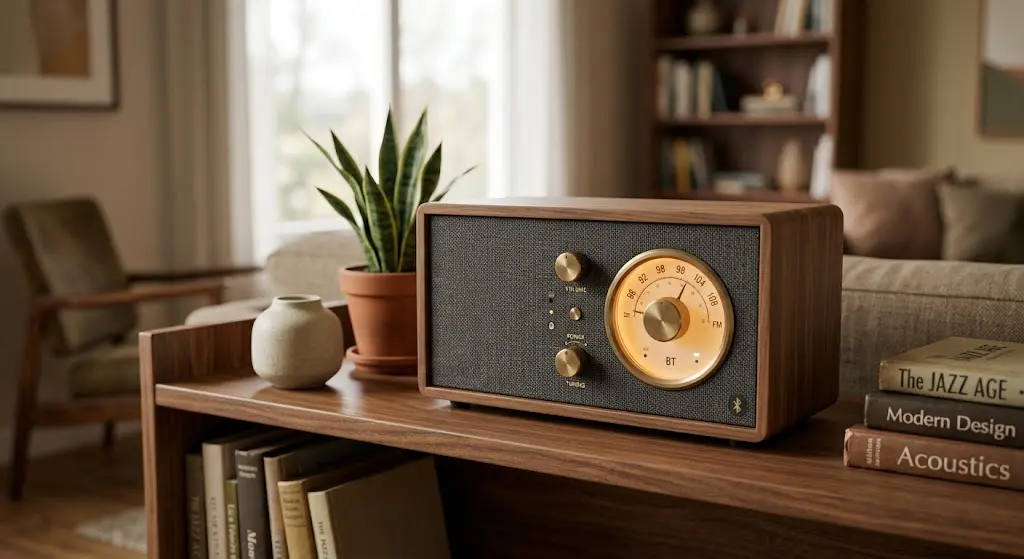
Why Retro-Style Speakers Are Taking Over Home Decor Again
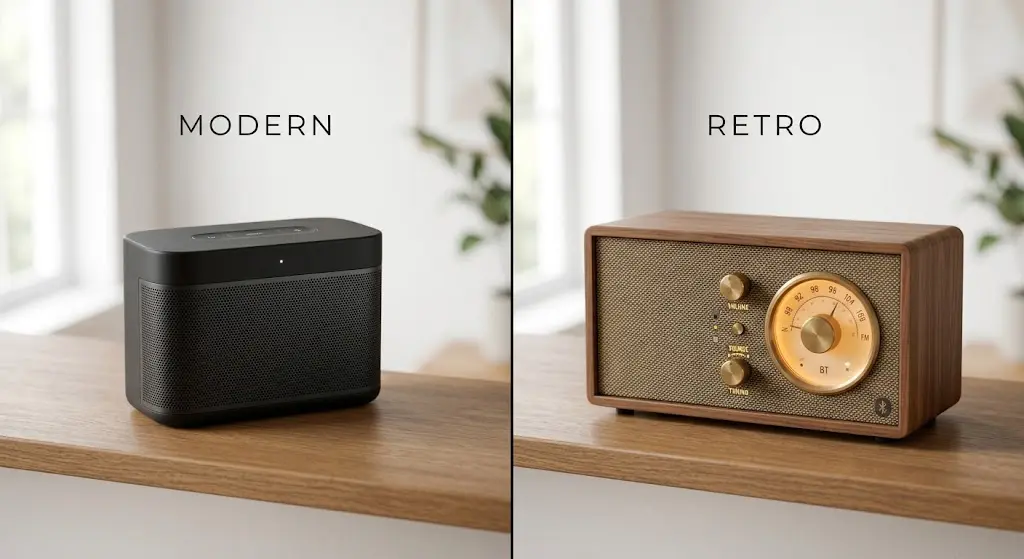
Modern speakers often look like black boxes. They work well, but they add nothing to a room. Retro speakers solve that problem. Wood grain, fabric grilles, brass knobs, and analog-style dials turn a speaker into a decor piece.
Design blogs and audio review sites report growing demand for speakers modeled on 1950s to 1980s radios, reel-to-reel recorders, and vintage hi-fi consoles. People want a speaker that looks good turned off, not only when playing music.
Three reasons drive this shift:
- Home decor trends favor warmth over minimalism. Wood and brass feel more personal than plastic and glass.
- Bluetooth technology matured. You no longer trade sound quality for a vintage shell.
- People spend more time at home and want spaces that feel curated, not generic.
What Makes a Bluetooth Speaker Truly Retro
Not every speaker labeled “vintage” earns the name. A few traits separate genuine retro design from a plastic shell painted brown.
Materials. Solid wood cabinets, metal grilles, leather-look wrapping, and brass or chrome knobs signal real craftsmanship. Thin plastic with a wood-print sticker does not hold up over time.
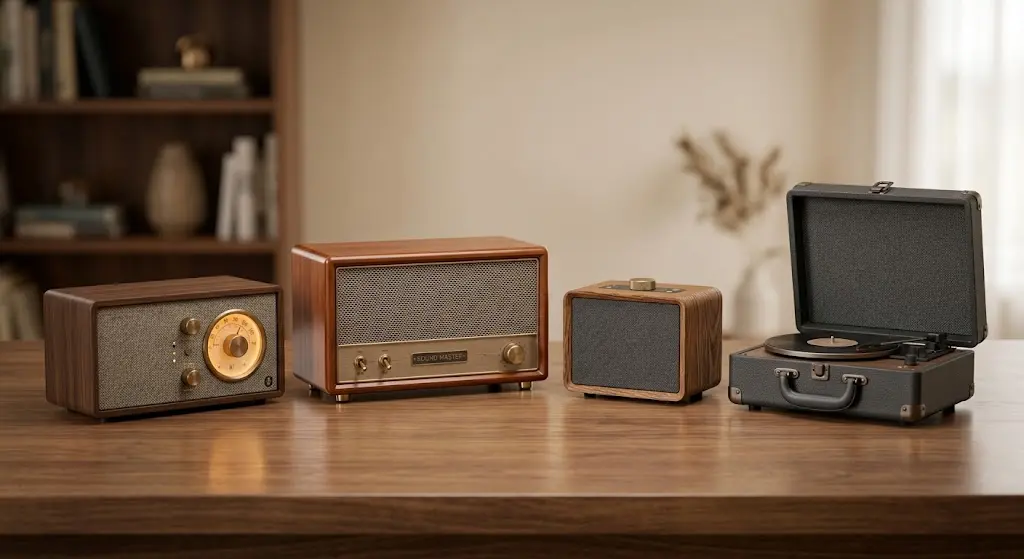
Design references. Strong retro speakers borrow from specific eras. Rounded tabletop radios from the 1950s, suitcase record players from the 1960s, and stereo consoles from the 1970s each bring a distinct look. Pick a reference that matches your existing furniture.
Modern internals. A speaker only earns a spot in your home if the sound holds up. Look for Bluetooth 5.0 or newer, full-range drivers, a passive radiator for bass, and a battery that lasts eight hours or more if you plan to move it around.
Function beyond looks. Many retro speakers add an FM radio, an aux input, or USB charging. These extras matter if you want the speaker to work as a full room centerpiece, not a silent shelf ornament.
A Real Scenario: Furnishing a Mid-Century Apartment on a Budget
Consider a common situation. Someone moves into a small apartment and furnishes it with mid-century modern pieces: a walnut credenza, a teak coffee table, warm brass lighting. A modern black speaker on the shelf breaks the whole look. It stands out for the wrong reason.
The fix is not complicated. Swapping the black speaker for a walnut wood model with a fabric grille and brass dial ties the shelf together. The speaker stops looking like tech equipment and starts looking like furniture. Sound quality stays the same or improves, since many retro models now use the same drivers found in standard Bluetooth speakers.
This pattern repeats across kitchens, home offices, and bedrooms. The lesson stays simple: match the speaker’s material and color to the room’s existing palette, not the other way around.
Best Retro-Style Bluetooth Speakers for Home Decor
Below are strong picks across price ranges, based on build quality, sound performance, and how well each fits a decor-focused home.
Marshall Acton III: Best Overall Retro Design
The Acton III carries Marshall’s signature amplifier look into a home speaker. Brass control knobs, the Marshall script badge, and a leather-style finish give the unit a rock-and-roll edge that still fits a living room shelf. Inside, a two-way driver system with outward-angled tweeters delivers a wide soundstage. Bluetooth 5.2 handles wireless pairing, and a 3.5mm aux input covers wired setups. The speaker ships in classic black or vintage cream, so it adapts to different color schemes.
Read the official product details on Marshall’s website.
Victrola Willow: Best Radio-Style Look
The Willow copies the shape of a classic tabletop radio. A wood cabinet houses built-in stereo speakers, and a dial-based front panel adds authentic detail. Bluetooth pairing works with phones, tablets, and laptops, and a built-in AM/FM tuner adds a second way to listen. This model suits living rooms, studies, and any space built around a traditional or rustic look.
Greadio Retro Wood Speaker: Best Budget Pick
Real walnut wood construction sets this speaker apart from cheaper plastic models at a similar price. A dual-driver setup with bass enhancement gives it a fuller sound than the compact size suggests. An FM radio function adds range beyond Bluetooth streaming. Reviewers highlight the wood finish blending well with existing furniture, along with reliable Bluetooth 5.0 connectivity.
Klipsch The One Plus: Best Sound Quality
For anyone who treats sound as the top priority, Klipsch built a 2.1 speaker system into a compact wood-and-fabric cabinet. The dedicated subwoofer driver adds bass depth most retro-styled speakers cannot match. The design leans toward a vintage hi-fi console rather than a radio, with clean lines and a walnut finish that suits modern or mid-century rooms alike.
How to Choose the Right Retro Speaker for Your Space
Follow these steps before buying.
- Measure your shelf or surface space first. Retro speakers range from pocket-sized to full console width. A speaker too large for its spot overwhelms a room instead of complementing it.
- Identify your decor era. Mid-century modern pairs well with wood and brass. Industrial decor pairs better with metal grilles and darker tones. Match the speaker to what already sits in the room.
- Set a sound priority. If background music matters more than volume, a compact model works fine. If you host gatherings or want a living room centerpiece, choose a model with a passive radiator or a dedicated subwoofer.
- Check the battery life if portable. Look for eight hours minimum. Kitchen and outdoor use drain batteries faster than a speaker that stays plugged in on a shelf.
- Confirm connectivity beyond Bluetooth. An aux input covers older devices. USB charging keeps the speaker useful as a power bank in a pinch.
- Read return policies before buying online. Wood grain and color vary by photo. A flexible return window protects you if the finish does not match your room in person.
Where to Place Your Retro Speaker for Maximum Decor Impact
Placement changes how much a speaker adds to a room.
- Living room shelves work well for console-style and radio-style speakers. Place the speaker at eye level or slightly above for the best visual impact.
- Kitchen counters suit compact wood speakers with FM radio, since they double as a cooking companion.
- Home office desks benefit from smaller radio-style models that do not crowd a workspace.
- Bedroom nightstands work best with speakers under eight inches wide, paired with warm, low lighting nearby to match the vintage tone.
Avoid tucking a retro speaker into a corner or behind other objects. Part of the value comes from being seen, not only heard.
Common Mistakes People Make When Buying Retro Speakers
Buying on looks alone. A speaker that looks perfect in photos can sound thin or distorted at higher volumes. Check for real driver specs, not marketing language alone.
Ignoring room size. A small tabletop speaker cannot fill a large open-plan living room. Match power output, measured in watts, to the size of your space.
Skipping the return window. Wood tone and cabinet size look different online than in person. A short or non-existent return policy raises risk.
Overlooking weight. Solid wood cabinets weigh more than plastic ones. If you plan to move the speaker often, check the weight before buying.
Safety Tips for Using Retro Bluetooth Speakers at Home
- Keep wood-cabinet speakers away from direct sunlight and heat sources. Prolonged heat warps wood and fades finish over time.
- Charge battery-powered models with the cable included by the manufacturer. Third-party cables sometimes deliver incorrect voltage.
- Keep speakers away from water sources unless the model states a water-resistance rating.
- Unplug plug-in models during storms or long absences, the same precaution you would take with any other home electronics.
- Store unused batteries or power banks at room temperature, away from direct heat.
FAQ: Retro-Style Bluetooth Speakers for Home Decor
What is the difference between a vintage speaker and a retro-style Bluetooth speaker? A true vintage speaker is an original unit from decades past, often without Bluetooth. A retro-style Bluetooth speaker is a new product built with vintage design cues, wood, brass, dials, paired with modern wireless technology.
Do retro-style speakers sound worse than modern minimalist speakers? No. Sound depends on the drivers and internal components, not the outer shell. Many retro models use the same driver technology found in standard modern speakers.
How long does a retro Bluetooth speaker battery last? Strong models offer eight to twelve hours of continuous playback. Plug-in console-style speakers, like the Marshall Acton III, run on constant power and do not rely on a battery.
Can a retro speaker connect to more than one device? Most current models support Bluetooth multipoint or fast re-pairing between paired devices, though the exact feature set varies by brand and model. Check the product page for the specific speaker before buying.
Where do retro Bluetooth speakers fit best in a small apartment? A single shelf, credenza top, or kitchen counter works well. Pick a compact model for tight spaces and reserve larger console-style speakers for apartments with more open shelving.
Are wood-cabinet speakers harder to maintain than plastic ones? Wood needs a bit more care around sunlight and moisture, but a dry cloth and a spot away from direct heat keeps most models in good shape for years.
Further Reading