
Learning how to choose the right wireless earbuds can feel overwhelming when you are staring at endless product pages and conflicting reviews. One site praises a expensive flagship model, while another swears by a budget brand you have never heard of. Meanwhile, your old earbuds just died and you need a reliable pair before your next trip.
This guide cuts through the noise. No brand worship, no jargon dump. Just the factors that decide whether a pair of earbuds fits your ears, your budget, and your daily routine, plus a step-by-step process you can follow today.
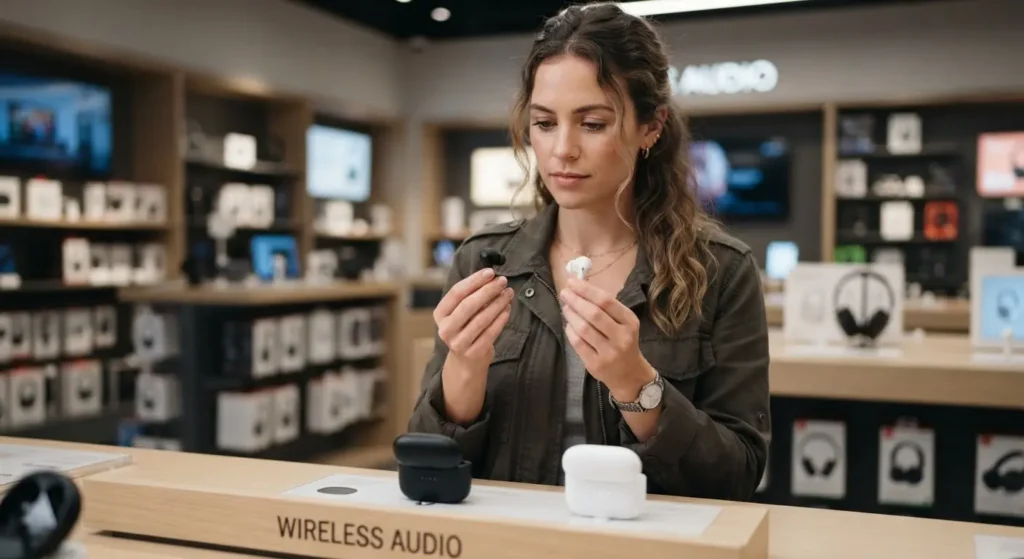
Why the Right Pair of Earbuds Matters More Than the Price Tag
A cheap pair that fits your ears and survives your gym sessions beats an expensive pair that falls out during a jog or dies after two hours. Picking earbuds is not about chasing the highest spec sheet. Fit, battery habits, and daily use decide satisfaction far more than a brand name does.
Buy the wrong pair and you face three common outcomes:
- Earbuds that hurt after thirty minutes and sit in a drawer
- A battery that drains before your workday ends
- A return process that eats your time and your patience
The right pair, on the other hand, disappears into your routine. You stop thinking about them and start using them.
8 Factors to Check Before You Buy
1. Sound Quality
Sound quality shapes how music, podcasts, and calls feel in your ears. Look for a balanced frequency response rather than bass that drowns out vocals. Bass-heavy tuning sounds fun in a five-minute store demo but tires the ear over a full workday. Sites like <a href=”https://www.rtings.com/headphones” target=”_blank” rel=”noopener noreferrer”>RTINGS</a> measure frequency response with lab equipment, so their numbers give you a starting point beyond marketing claims.
If you listen mostly to podcasts and audiobooks, prioritize clear mid-range and vocal clarity over deep bass. If you listen to hip-hop, EDM, or bass-forward genres, a stronger low end pays off.
2. Battery Life
Battery life covers two numbers: playback time per charge and total time with the charging case. A pair rated for 6 hours per charge and 24 hours with the case suits most commuters and office workers. Runners training for long distances need at least 8 hours per charge, since a mid-run recharge is not an option.
Check real-world battery tests rather than marketing claims. Manufacturers test under ideal conditions; actual battery life with noise cancellation on runs shorter.
3. Fit and Comfort
Fit decides whether you wear your earbuds for ten minutes or ten hours. Ears come in different shapes, so a pair praised online can feel wrong in your ears. Three earbud shapes dominate the market:
- In-ear (with silicone tips): best noise isolation, common irritation risk for long sessions
- Semi-in-ear (like AirPods): lighter feel, weaker noise isolation
- Open-ear (bone conduction or hook style): best for outdoor awareness, weakest bass and isolation
Most brands include three or four tip sizes in the box. Test each size and check for a light seal, not a jammed one. A correct fit stays in place when you shake your head gently and does not ache after twenty minutes.
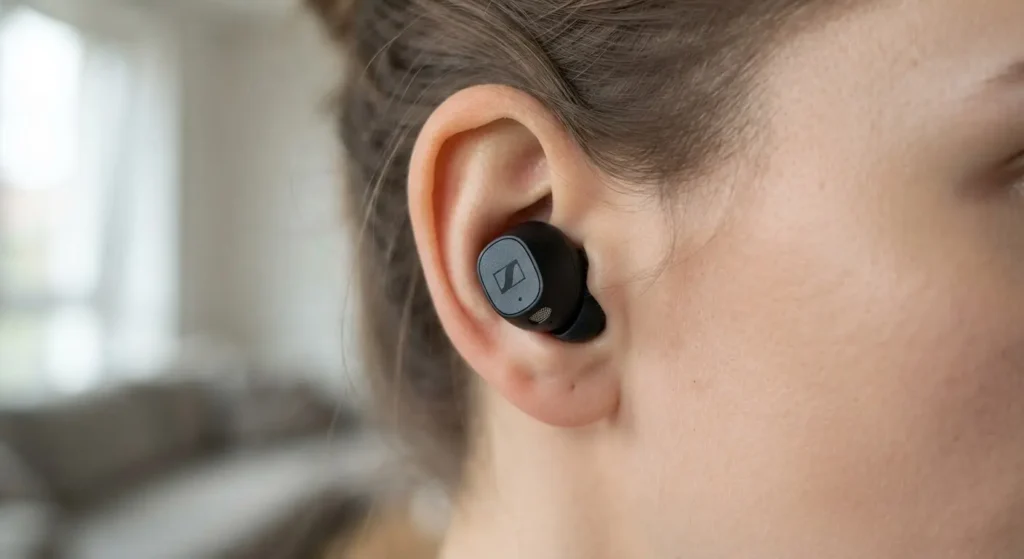
4. Noise Cancellation
Active noise cancellation (ANC) uses microphones to cancel outside sound waves, useful on flights, in open offices, and on busy streets. Passive isolation, created by the physical seal of the ear tip, blocks sound without electronics and drains no battery.
If you work in a noisy office or fly often, ANC earns its price premium. If you walk or cycle in traffic, skip ANC or use transparency mode, since blocking traffic sounds raises your risk on the road.
5. Water and Sweat Resistance
Check the IP rating printed on the box or listed on the product page. IPX4 resists sweat and light rain, enough for most gym sessions and light drizzle. IPX7 survives full submersion for a set time, a better match for heavy sweat, rain runs, or accidental drops in water. Skip this factor only if you use your earbuds exclusively indoors in dry conditions.
6. Bluetooth Connection and Codec Support
Bluetooth version and codec support decide connection stability and audio quality. Bluetooth 5.2 or newer reduces dropouts and lowers power use compared to older versions. Codec support matters for audio quality: AAC works well with iPhones, while aptX and LDAC give Android phones a higher-quality wireless stream when the phone and earbuds both support them.
Multipoint connection lets your earbuds pair with two devices at once, such as your laptop and your phone, and switch between calls and music without a manual reconnect. This feature saves real time if you work across a laptop and phone during your day.
7. Controls and Companion App
Physical buttons resist accidental taps but need a firm press that pushes the earbud into your ear canal. Touch controls respond to a light tap but trigger accidental skips when you adjust your earbuds or when rain hits the surface.
A companion app adds custom equalizer settings, firmware updates, and find-my-earbuds tracking. Check whether the app works on both Android and iOS if your household uses different phone brands.
8. Price and Warranty
Set a budget range before you start comparing models, then match features to that range instead of chasing every available feature. A $50 to $100 pair now covers ANC, decent battery life, and IPX4 resistance for most casual and office use. Premium pairs above $200 add better ANC, richer sound tuning, and stronger app features, worth the price for daily flyers, audio professionals, and heavy commuters.
Check the warranty length and what it covers. Battery degradation after a year of daily charging is common and not always covered, so read the fine print before you buy.
A $50 to $100 pair now covers ANC, decent battery life, and IPX4 resistance for most casual and office use. Check out our Earbuds Collection to explore available options within your budget.”
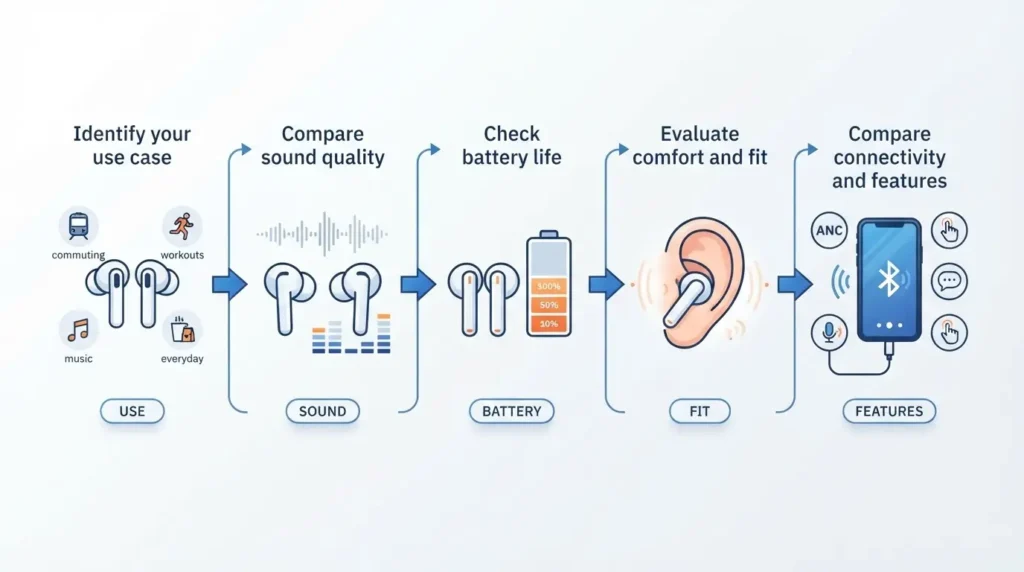
How to Choose the Right Wireless Earbuds: Step-by-Step Guide
Follow these steps in order. Each step narrows your options until one or two pairs remain.
- Define your main use case. Write down the top two activities: commuting, gym, calls, gaming, or travel. Your top use case decides which features matter most.
- Set a budget range. Decide a minimum and maximum price before you browse, so marketing does not push you above your limit.
- Shortlist three to five models. Use review sites with lab-tested data, not only star ratings from online stores.
- Check the fit and IP rating. Confirm the ear tip sizes included in the box and the water resistance rating against your main use case.
- Compare battery life for your routine. Match the rated playback hours against your longest single-use session, such as a workday or a flight.
- Test in person when possible. Visit a store, try the demo unit, and walk around for a few minutes to check the seal and weight.
- Read return policy details before buying online. Confirm the return window covers at least two weeks of real-world testing.
- Buy, then break in the fit over the first week. Wear the earbuds for short sessions first and extend gradually to confirm long-term comfort.
Real Scenarios: Matching Earbuds to Your Life
Scenario 1: The Daily Commuter
Sarah rides the subway forty minutes each way, five days a week. Her old earbuds let train noise drown out her podcasts. She needed strong ANC, a secure in-ear fit for a moving train, and a case that recharges fast during a short lunch break. A mid-range ANC pair with a quick-charge case solved her problem: ten minutes in the case gave her two extra hours of playback.
Scenario 2: The Gym Regular
Marcus lifts weights four times a week and runs on weekends. Earbuds with a loose fit fell out during his sets. He switched to an in-ear pair with wing tips for a locked fit and an IPX7 rating to survive heavy sweat and post-workout rinses under the tap. Battery life mattered less for him, since his sessions run under an hour.
Scenario 3: The Remote Worker on Calls All Day
Aisha spends six hours a day on video calls. Her main complaint with her previous earbuds was clients complaining about background noise on her end. She moved to a pair with multiple microphones and call-focused noise reduction, plus multipoint connection to switch between her laptop and phone without a manual pairing step each time.
Common Mistakes People Make When Buying Earbuds
- Buying based on brand name alone, without checking fit or battery life for their own routine
- Ignoring the IP rating, then damaging earbuds with sweat or light rain
- Choosing ANC-heavy earbuds for outdoor running or cycling, which raises safety risk in traffic
- Skipping the return window check, then getting stuck with a pair that hurts after a week
- Assuming premium price always means premium comfort, when fit depends on ear shape, not price
A Buyer’s Real Experience
I once bought a pair of earbuds purely because a tech reviewer called them the best on the market. The sound was strong. The fit was wrong for my ears. Within a week, my right ear ached after any session past thirty minutes, and I stopped wearing them for anything longer than a quick call.
The pair I use now costs less than half the price of that first set. The tip size matched my ear canal, the battery covers my workday without a midday charge, and the app lets me turn off touch controls I kept triggering by accident while adjusting my glasses. The lesson stuck with me: read the lab numbers, then trust your own ears over anyone else’s ranking list.
Frequently Asked Questions
How long should wireless earbuds last before I replace them? Most wireless earbuds hold a usable battery for eighteen months to three years of daily charging before the battery capacity drops enough to affect daily use. Charging habits, heat exposure, and full-drain cycles speed up this decline.
Are expensive earbuds always better than budget ones? No. Price often reflects brand reputation, ANC quality, and app features, not raw comfort or fit. A $40 pair with the right ear tip size beats a $250 pair that does not seal your ear canal correctly.
What Bluetooth version should I look for in 2026? Bluetooth 5.2 or newer gives you a stable connection and lower power draw. Bluetooth 5.3 and 5.4 models add further stability improvements and support newer low-latency audio standards.
Is active noise cancellation safe to use while walking outside? ANC blocks environmental sound, including traffic and warning signals, which raises risk near roads. Switch to transparency mode or skip ANC entirely when you walk, run, or cycle near traffic.
How loud is too loud for daily earbud use? Health organizations, including the CDC, link volumes above 85 decibels over extended periods to hearing damage risk. The 60/60 rule, keeping volume at 60 percent of maximum for no more than 60 minutes at a stretch, gives your ears a safety margin. See the https://www.soundguys.com/how-to-find-out-how-loud-your-headphones-are-62390 and the Hearing Health Foundation’s headphone safety guide for more detail on safe listening habits.
Do I need noise cancellation if I mostly work from home? A quiet home office needs less ANC power than a train platform or open floor plan. Passive isolation from a well-fitted ear tip often covers home use without the added cost of top-tier ANC.
Can one pair of earbuds work for both gym use and office calls? Yes, for most people. Look for an IPX4 rating or higher for sweat resistance, multiple microphones for call clarity, and a secure fit tested during light movement. A single all-purpose pair covers both use cases well for casual gym-goers and light runners.

Final Thought
The best wireless earbuds are the ones that match your ears, your routine, and your budget, not the ones topping a generic ranking list. Walk through the eight factors above, run the step-by-step process, and check your own experience against the lab data. Your ears will thank you within the first week.
For further reading on lab-tested models across price ranges, check https://www.rtings.com/headphones/reviews/best/wireless-earbuds
https://www.techradar.com/news/audio/best-in-ear-headphones-1276925