
When choosing audio gear, understanding Bluetooth 5.3 vs 5.4 vs 6.0 is crucial, yet you might find yourself staring at a product page unsure of what those numbers actually mean. One box says Bluetooth 5.3, another 5.4, and a third brags about 6.0 while acting like the higher number automatically guarantees better sound.
Here is the short version: the Bluetooth version number on the box tells you almost nothing about how your music will sound. It tells you about range, connection stability, power draw, and a handful of background features you will never see in a spec sheet review. Sound quality comes from the codec, not the version number.
This guide breaks down what changed in Bluetooth 5.3, 5.4, and 6.0, what each change means for real headphones and earbuds, and how to pick gear without paying extra for a number you do not need.
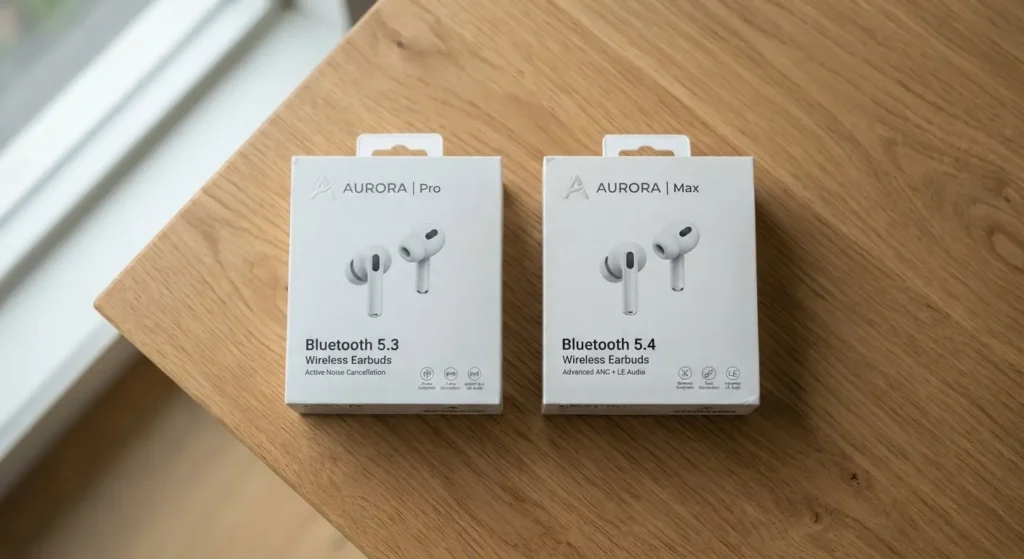
What the Bluetooth version number actually controls
Bluetooth version numbers describe the core specification, the rulebook that chip makers follow when they build a Bluetooth radio. Each new version adds features to that rulebook. It does not rewrite how audio gets compressed and sent to your ears.
The version number affects:
- How far your device can stay connected before it drops
- How much battery the connection drains
- How many devices you can pair or switch between
- Background security and pairing behavior
- How devices find each other and stay in sync
The version number does not affect:
- How good your music sounds
- Which audio codec your earbuds support (SBC, AAC, aptX, LDAC, LC3)
- Bass response, soundstage, or driver quality
If a seller tells you Bluetooth 6.0 earbuds sound better than Bluetooth 5.0 earbuds because of the version number alone, you are talking to someone who has not read the spec. Audio quality rides on the codec and the hardware, not the version.
Bluetooth 5.3 explained in plain terms
Bluetooth 5.3 came out in 2021 and now ships in most mid-range and premium earbuds on the market. It focused on efficiency and stability rather than flashy new tricks.
The core additions in 5.3:
- Connection Subrating, which lets a device switch faster between low-power standby and active audio streaming. Your earbuds wake up quicker when a call comes in.
- Better control over pairing security, including tighter rules on minimum key length, so devices spend less time negotiating and avoid weak encryption.
- Cleaner, faster data exchange between paired devices, which reduces small audio hiccups during streaming.
For a listener, 5.3 means a slightly more stable connection and marginally better battery life compared to 5.0 or 5.1 gear, especially in crowded Bluetooth environments like offices or gyms. It is a mature, well-tested version. Most manufacturers still build around it because the chips are cheap and reliable.
Bluetooth 5.4 explained in plain terms
Bluetooth 5.4 builds on 5.3 with two additions aimed mostly at large-scale IoT devices, not headphones.
- Encrypted Advertising Data (EAD), which protects the small broadcast signals devices send before they even pair, useful for asset tags and smart locks more than earbuds.
- Periodic Advertising with Responses (PAwR), which lets one central device talk to hundreds of endpoints in a synced cycle, built for warehouse sensors and large smart-building deployments.
For headphones and earbuds, 5.4 rarely changes your daily experience. You get a slightly hardened security layer during device discovery, but audio streaming, range, and sound quality stay the same as 5.3. If you see 5.4 stamped on a pair of earbuds, treat it as a marketing detail, not a reason to pay more.
Bluetooth 6.0 explained in plain terms
Bluetooth 6.0 launched in September 2024 and is a bigger jump than 5.3 to 5.4. The headline feature is Channel Sounding, which lets two Bluetooth devices measure the distance between them with accuracy down to about 10 centimeters, using phase-based ranging and round-trip time measurement instead of signal strength guessing.
Channel Sounding matters for:
- Digital car keys and smart locks that need to confirm you are actually standing at the door
- Find My style item trackers that need precise location, not a rough estimate
- Secure access systems that resist relay attacks
Bluetooth 6.0 also adds Decision-Based Advertising Filtering and Monitoring Advertisers, both aimed at helping devices scan more efficiently and use less power while searching for nearby gear.
None of this changes how your headphones sound. Chip makers only started shipping Bluetooth 6.0 controllers in early 2025, and mass consumer adoption in earbuds and headphones is still rolling out through 2026. If you buy a pair advertised as Bluetooth 6.0 today, you are paying for a newer chip generation, not a proven audio upgrade.
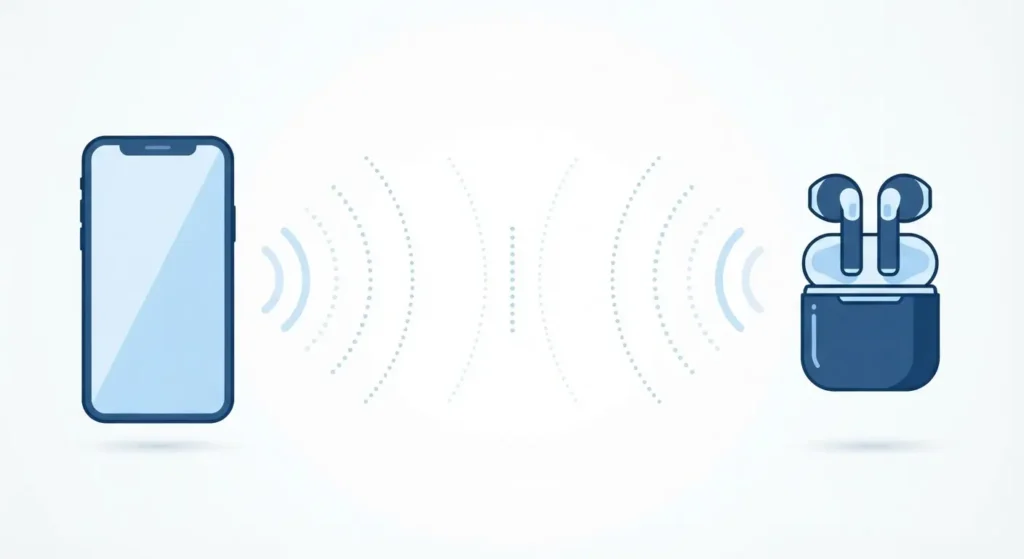
The codec myth: why the version number does not equal sound quality
This is the part most product listings get wrong, on purpose or by accident.
Bluetooth audio quality depends on the codec your earbuds and your source device both support. Common codecs, from basic to advanced:
- SBC: the default codec every Bluetooth audio device supports. Acceptable, not impressive.
- AAC: common on iPhones and many earbuds, solid quality for most listeners.
- aptX and aptX HD: lower latency and better bitrate, common on Android and gaming-focused gear.
- LDAC: Sony’s high-resolution codec, the closest Bluetooth gets to wired sound, but it needs strong signal strength to hold its top bitrate.
- LC3: the new codec built for LE Audio, more efficient than SBC at a similar bitrate and required for Auracast broadcast audio.
A pair of Bluetooth 5.0 earbuds with LDAC support will sound noticeably better than a pair of Bluetooth 5.4 earbuds stuck on SBC. Check the codec list on the product page before you check the version number. If a listing only shows the Bluetooth version and skips the codec entirely, treat that as a warning sign, not a selling point.
A real buying scenario
Say you are shopping for workout earbuds. You find two options at the same price. One lists Bluetooth 5.4 and SBC only. The other lists Bluetooth 5.2 and aptX Adaptive plus AAC.
Pick the second pair. The version number gap barely affects your workout playlist. The codec gap does. aptX Adaptive gives you lower latency, which matters if you also watch videos or take calls, and better resistance to dropouts when your phone is in a pocket during a run.
This mistake shows up constantly in budget and mid-range shopping. A brand ships an older codec stack but bumps the Bluetooth version because it is a cheap way to look current on a spec sheet. Reading past the headline number saves you from paying for a number instead of a feature.
How to check which Bluetooth version and codec your gear actually supports
Follow these steps before you buy or before you troubleshoot a pair you already own.
- Open the product listing and scroll to the full specifications, not just the headline bullets. Look for a “Bluetooth” or “Wireless” section.
- Search the spec sheet for the word codec. If you only see the Bluetooth version number and nothing about SBC, AAC, aptX, or LDAC, assume the device only supports SBC.
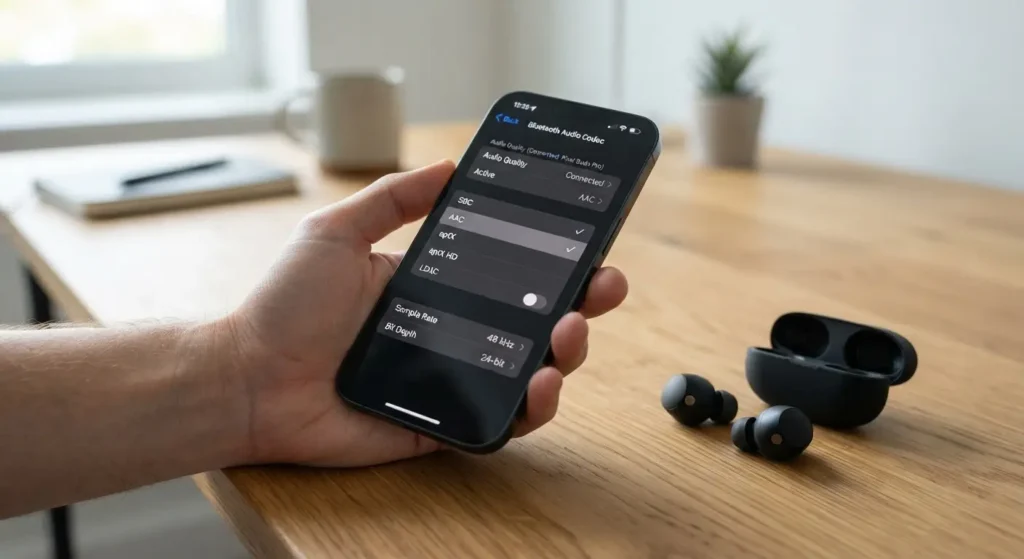
- Check your phone’s supported codecs. On Android, go to Settings, then Developer Options, then Bluetooth Audio Codec, to see and force a specific codec. On iPhone, AAC is the ceiling, since Apple does not support aptX or LDAC.
- Match the two lists. Your final audio quality is capped by whichever device, phone or earbuds, supports the lower codec.
- If range or connection drops are your real concern rather than sound, prioritize Bluetooth 5.2 or later, since Connection Subrating and improved coexistence in 5.2 and 5.3 genuinely reduce dropouts in crowded wireless environments.
- If you need multipoint, meaning your earbuds stay connected to two devices at once, like a laptop and a phone, check for that feature by name in the listing. It usually shows up starting around Bluetooth 5.2 hardware, but manufacturers implement it inconsistently, so confirm it directly instead of assuming from the version number.
Bluetooth 5.3 vs 5.4 vs 6.0: Which Version Should You Actually Buy?
For everyday earbuds and headphones
Bluetooth 5.2 or 5.3 with AAC or aptX is enough for almost every listener. Do not pay a premium for 5.4 or 6.0 on audio gear alone. Spend the extra money on the codec and driver quality instead.
For gaming earbuds
Look for aptX Low Latency or a dedicated low-latency mode over the version number. Bluetooth 5.2 or 5.3 with a proper low-latency codec beats Bluetooth 5.4 with only SBC.
For smart home devices, trackers, and digital keys
Bluetooth 6.0 is worth seeking out here, since Channel Sounding directly improves how these devices confirm your location and resist spoofing. This is the one category where the new version number maps to a real, usable feature today.
For budget shoppers
Do not chase the newest version number. A well-reviewed Bluetooth 5.0 or 5.1 pair with a stable connection and decent codec support will outperform a cheap Bluetooth 5.4 pair that cut corners on the audio chip to hit a lower price.
FAQ
Does Bluetooth 5.4 sound better than Bluetooth 5.3? No. Sound quality depends on the audio codec, not the Bluetooth version. Bluetooth 5.4 mainly adds security and IoT networking features that do not touch audio streaming quality.
Is Bluetooth 6.0 backward compatible with my Bluetooth 5.0 phone? Yes. Bluetooth maintains backward compatibility across versions. Your Bluetooth 6.0 earbuds will pair with a Bluetooth 5.0 phone, but you will not get Channel Sounding or the other new 6.0 features unless both devices support them.
Should I avoid buying Bluetooth 5.3 earbuds in 2026? No. Bluetooth 5.3 is mature, widely tested, and still used in most mid-range and premium earbuds. It remains a solid choice unless you specifically need a Bluetooth 6.0 feature like Channel Sounding.
What is the single most important spec besides the Bluetooth version? The audio codec. Check for AAC as a baseline on iPhone, and aptX or LDAC support if you use Android and care about high-resolution streaming.
Does a higher Bluetooth version mean longer battery life? Not automatically. Efficiency improvements like Connection Subrating in 5.3 can extend battery life slightly, but battery capacity and the earbud’s power management design matter far more than the version number.
What is Auracast and do I need Bluetooth 6.0 for it? Auracast is a broadcast audio feature that lets public venues, like gyms or airports, send audio directly to compatible Bluetooth earbuds. It arrived with LE Audio in Bluetooth 5.3 and 5.4, not 6.0, but it needs LC3 codec support and is still rare in public spaces as of 2026.
Further reading
- Bluetooth SIG official announcement on Core Specification 6.0
- Bluetooth Core 6.0 feature overview from Bluetooth.com
- Silicon Labs breakdown of Bluetooth 6.0 Channel Sounding
If you are looking for workout earbuds with top codec support, check out our Earbuds Collection