
Finding the best portable speakers for camping and outdoor adventures isn’t just about picking high volume. You pack the tent, the cooler, and the firewood, but then you get to the campsite and your speaker dies after two hours, or the sound gets lost in the wind.
Camping speakers face conditions a living room speaker never sees: dust, rain, drops on rock, hours of playback with no outlet nearby. This guide walks you through what actually matters, which models hold up in the field, and how to protect the one you buy.
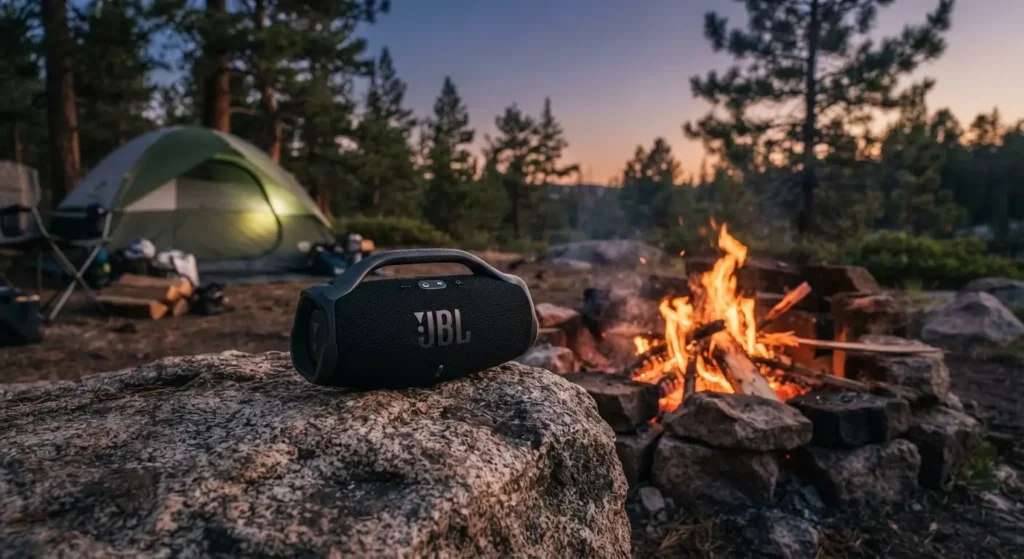
What Makes a Speaker Good for Camping
Not every “outdoor” label on a product page means much once the speaker leaves the store. Four factors decide whether a speaker survives a real trip.
Waterproof and Dustproof Rating
Look for an IP rating, two numbers after “IP” (for example IP67). The first number covers dust resistance, the second covers water. A rating of IP67 means the speaker seals out dust completely and survives full submersion for up to 30 minutes. Anything below IPX6 handles light rain but not a drop into a creek or a dusty campsite floor.
Battery Life That Matches Your Trip
Manufacturers list battery life at 50% volume, a number that rarely matches how loud you actually play music around a fire pit. Testers who track speakers on real trips report that battery life drops to 60-75% of the advertised figure once volume climbs to 70-80%. A speaker rated for 20 hours often gives you closer to 14-15 hours at a volume loud enough to hear over conversation and wind.
Cold weather cuts battery life further. Multiple campers on outdoor forums report battery capacity dropping by half in temperatures under 40°F (4°C). Keeping the speaker in a jacket pocket or your sleeping bag overnight helps preserve charge.
Volume and Sound Fill
A speaker that sounds fine on your kitchen counter often disappears at a campsite 30 feet wide. Wattage output gives you a rough guide: 10-12W works for a two-person tent site, 20W and above fills a larger group site or covers wind and campfire noise.
Weight and Size for Backpacking
Car campers have room for a heavier, louder speaker. Backpackers count every ounce. A speaker under 1 pound with a carabiner clip attaches to a pack strap and adds almost no weight to your load.
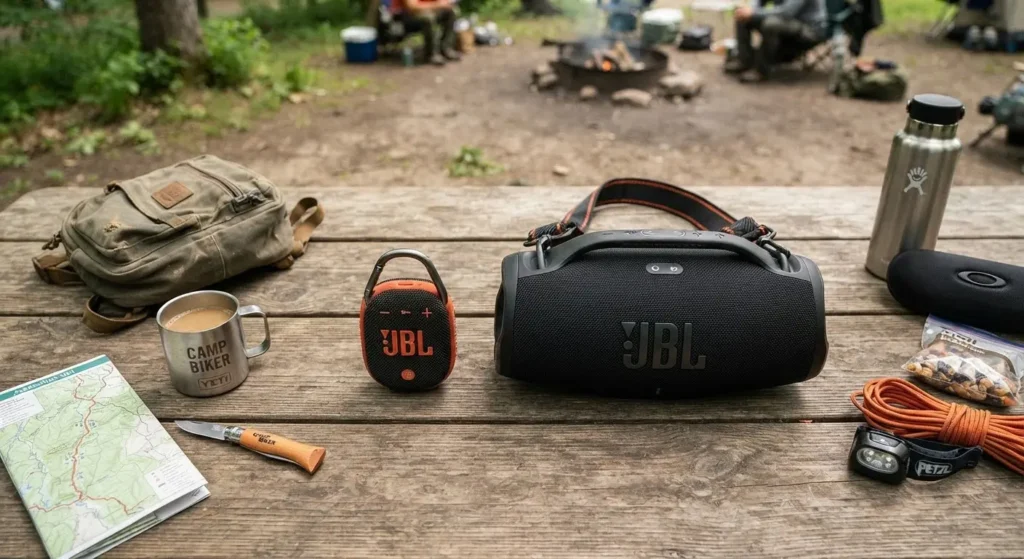
Best Portable Speakers for Camping in 2026
Here’s how the top options break down by use case, based on real specs and field reports from campers.
JBL Charge 5 (Best Overall)
The Charge 5 pairs an IP67 rating with roughly 20 hours of battery life and a built-in power bank that charges your phone through a USB-A port. Testers who compared it against lighter competitors found it wins on raw volume and battery life, though it weighs more than compact alternatives. If you want one speaker for the whole weekend that doubles as a phone charger, this is the pick.
Anker Soundcore Boom 2 (Best Value)
The Boom 2 delivers 80W of output, an IPX7 floatable design, and around 24 hours of battery life for well under the price of premium brands. One reviewer ran it for a full weekend at a state park, playing music around 7 hours a day, and still had charge left on the drive home. BassUp technology adds low-end warmth that budget speakers often lack.
Ultimate Ears Wonderboom 4 (Best for Rough Handling)
Small enough for a daypack, the Wonderboom 4 is fully waterproof and floats if it drops in a lake. It delivers around 24 hours of battery life and a 10-minute quick charge tops it back up fast. UE speakers have a reputation for surviving drops and rough handling, and this model keeps that standard.
JBL Clip 5 (Best for Backpackers)
Under a pound with a built-in carabiner, the Clip 5 clips straight onto a backpack strap. Battery life caps around 12 hours, shorter than the larger models, but the weight savings matter most when every ounce in your pack counts.
Marshall Emberton III (Best Sound Quality)
Reviewers who tested a wide range of speakers in 2026 named the Emberton III the best all-around Bluetooth speaker for balancing sound quality, battery life, and ruggedness. It carries an IP67 rating and battery life reported above 32 hours, among the longest in its class.
JBL Go 4 or Anker Soundcore 2 (Best Budget Picks)
For a backup speaker or a tight budget, the JBL Go 4 offers IP67 dustproofing and app-controlled EQ for under $50, though battery life runs around 7 hours. The Anker Soundcore 2 costs even less, around $30, and delivers a surprisingly accurate 22-24 hours of battery life with IPX7 waterproofing, based on a three-day car camping test in Big Sur.
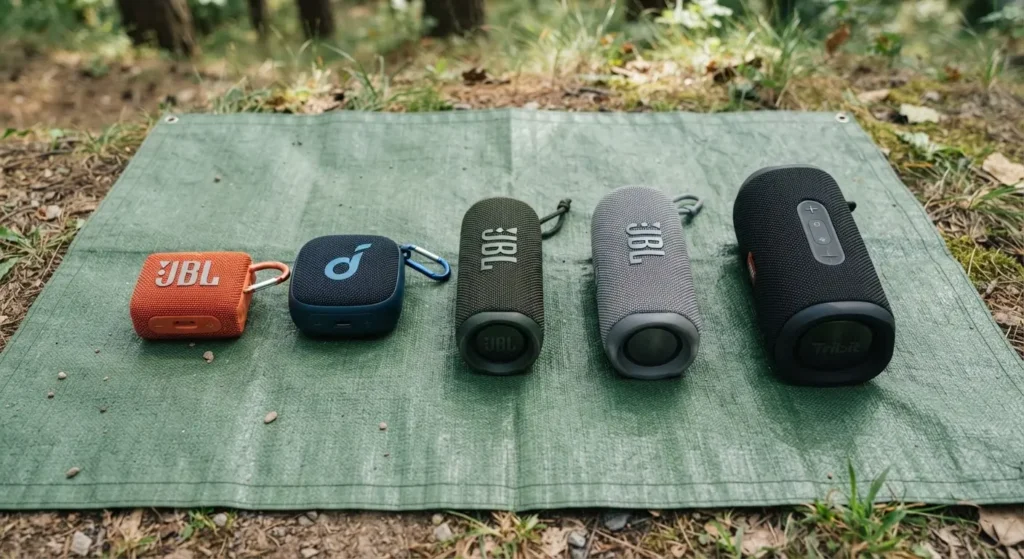
A Real Scenario: What Actually Happens on a Trip
Picture a three-day weekend at a state park. Day one, you set up camp and play music while cooking dinner, maybe two hours at moderate volume. Day two, a full day of activity: music while hiking to a viewpoint, then hours around the fire in the evening, six or seven hours total. Day three, a shorter morning session before packing up.
That adds up to roughly 10-12 hours of real playback across the weekend, not the single continuous stretch the “20-hour battery” number implies. A speaker rated for 20 hours at 50% volume, played at a more realistic 70-80% volume around a group, gives you closer to 14 hours. That still covers the trip with room to spare, but a speaker rated for only 10-12 hours cuts it close, especially if temperatures drop overnight and battery capacity dips.
This is why matching battery life to trip length, not just picking the biggest number on the box, saves you from a silent campsite on night two.
How to Choose Based on Your Trip Type
Car Camping
Weight barely matters when the car carries the gear. Prioritize volume and battery life. The JBL Charge 5 or Anker Soundcore Boom 2 both fit this use case, since you get loud, long-lasting sound without worrying about pack space.
Backpacking
Every ounce counts on the trail. Go for a clip-on model like the JBL Clip 5 or a compact floater like the UE Wonderboom 4. Battery life matters less here since backpacking days involve less continuous playback than a lounging car camp.
Group Trips and Festivals
Look for speakers that pair together, like the JBL Charge 5 or Anker models with app-based stereo pairing, so two units create fuller coverage across a larger site. A model with an IP67 rating handles the dust kicked up by a crowd.
If you are also looking for audio gear for daily commuting or studying, check out our guide on the best wireless earbuds and headphones for college students.
How to Protect Your Speaker Outdoors: Step-by-Step
- Clip it to your pack or a dry bag. A carabiner or a dedicated dry bag keeps the speaker off wet ground and away from dirt at your feet.
- Keep at least 6 feet from an open fire. Embers and heat damage the housing and battery even on a rated speaker.
- Store it in your sleeping bag overnight in cold weather. Body heat slows the battery drain that cold temperatures cause.
- Rinse with clean water after sand or dust exposure. Even IP67-rated speakers benefit from a quick rinse to clear grit from the seams before it works its way in over repeated trips.
- Charge to full before you lose cell service or outlet access. Don’t rely on mid-trip charging from a car if your site is a long hike from the trailhead.
- Dry it fully before storing it in a bag. Trapped moisture inside a sealed compartment breeds mold on the fabric shell over time.
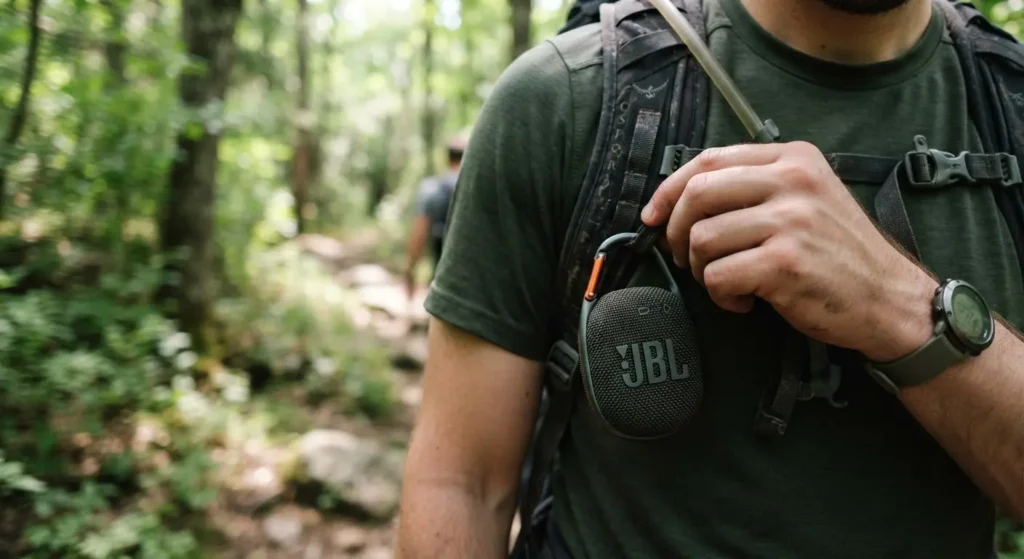
Common Mistakes Campers Make
- Buying based on price alone. A $20 speaker with no real IP rating often fails after one rainy trip, costing more in replacements than a mid-range model would have.
- Assuming “water-resistant” means “waterproof.” These are different ratings. Water-resistant speakers handle light splashes, not a drop in a stream.
- Ignoring weight for backpacking trips. A speaker that feels light in a store aisle feels heavy after ten miles on your back.
- Skipping a full charge before departure. Running a speaker down to 50% before leaving home cuts your usable trip time before you’ve played a single song.
- Leaving the speaker in direct sun on the dashboard. Heat degrades battery cells faster than cold does, and a hot car interior on the drive to the campsite adds up over a season.
FAQ
What IP rating do I need for camping? IP67 is the safe minimum for real outdoor use. It handles dust, sand, and a full accidental drop into water for up to 30 minutes. Anything rated only IPX5 or IPX6 handles rain but not submersion.
How long does a camping speaker battery actually last? Expect 60-75% of the advertised number once you play at a realistic outdoor volume of 70-80%. A speaker rated for 24 hours typically gives you 16-18 hours of real campsite use, less in cold weather.
Can two speakers pair together for louder sound? Yes, most major brands support stereo or party pairing through their app, letting you link two or more units for fuller coverage across a larger site. Check the specific model’s pairing limit before buying if this matters for your group size.
Is a Bluetooth speaker loud enough to hear over a campfire and wind? A speaker with at least 20W of output fills a standard campsite over typical fire crackle and light wind. For larger group sites or windier conditions, look for 40W or higher.
What’s the best speaker for solo backpacking trips? A clip-on model under 1 pound, like the JBL Clip 5, adds minimal weight and attaches directly to your pack. Battery life runs shorter than larger speakers, so plan around 10-12 hours of playback per charge.
Does cold weather really affect battery life? Yes. Campers report battery capacity dropping by roughly half in temperatures below 40°F. Storing the speaker close to your body, in a jacket pocket or sleeping bag, slows this effect.
Further Reading