
When comparing ANC vs ENC headphones, it helps to understand that each technology solves a completely different problem. You might be on a video call from a coffee shop with an espresso machine screaming behind you, or on a train home where engine noise drowns out your podcast. Most people mix these two technologies up and end up with the wrong pair.
Two different problems. Two different technologies. Most people mix them up, buy the wrong headphones, and end up frustrated twice.
This guide breaks down ANC and ENC in plain terms, shows you where each one shines, and helps you pick the right pair for how you actually use headphones.

What Is ANC (Active Noise Cancellation)?
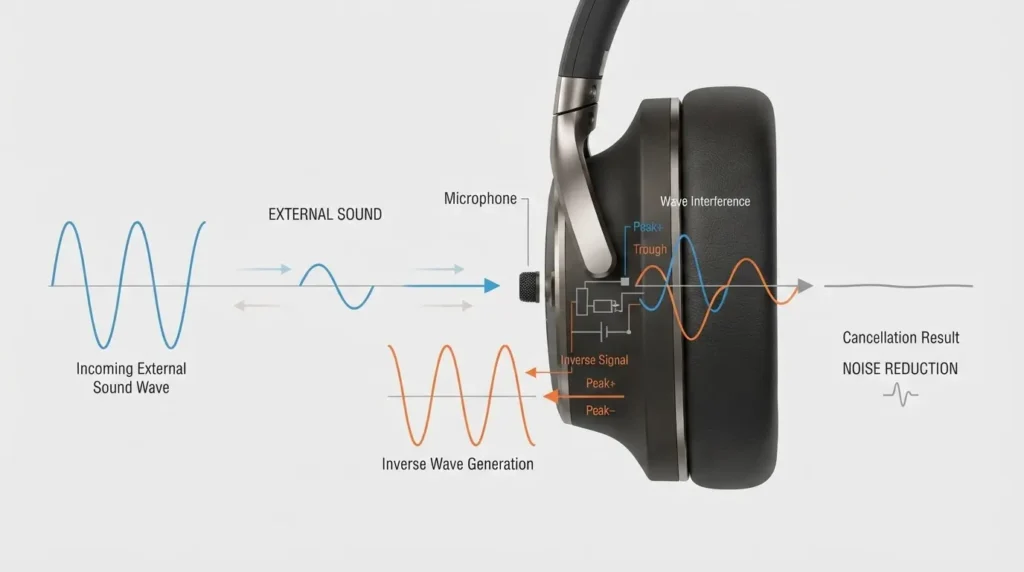
ANC stops outside noise from reaching your ears. Small microphones on the headphones pick up ambient sound such as engine hum, airplane roar, or office chatter. The headphones then generate a sound wave that is the exact opposite of that noise. The two waves cancel each other out before the sound hits your eardrum.
ANC works on what you hear. It has nothing to do with how you sound to other people.
Basic ANC systems cut noise by roughly 20 to 25 decibels. Higher-end models go further, especially against steady, low-frequency sounds like engine drone or HVAC hum. ANC struggles more with sudden, sharp noises such as a dog bark or a door slam.
Where ANC helps most:
- Long flights and train commutes
- Open offices with constant background chatter
- Studying or working in a loud environment
- Blocking out a noisy household so you can focus
The tradeoff: ANC needs power to run constantly, and it needs a sealed ear cup or eartip to work well. That affects battery life and comfort. Some people also describe a mild pressure sensation in the ears when ANC is active, similar to cabin pressure on a flight.
What Is ENC (Environmental Noise Cancellation)?
ENC works in the opposite direction. It cleans up your voice before it reaches the other person on a call. A microphone array on the headphones or earbuds picks up background noise near your mouth, isolates your voice from it, and strips out the noise before your audio gets sent.
ENC does not touch what you hear. It only affects your outgoing voice.
This is why ENC shows up on gaming headsets, work laptops, call center headsets, and true wireless earbuds built for meetings. If you have ever been on a call where the other person sounded crystal clear despite being in a loud room, that is ENC doing its job.
Where ENC helps most:
- Remote work calls and video meetings
- Gaming headsets where teammates need to hear you clearly
- Customer service and call center roles
- Recording voice notes or podcasts on the go
ENC uses less processing power than ANC because it only needs to isolate one voice from background noise, not cancel an entire soundscape. That is one reason ENC headphones often report longer battery life than ANC models on paper.

ANC vs ENC Headphones: Key Differences at a Glance
| Feature | ANC (Active Noise Cancellation) | ENC (Environmental Noise Cancellation) |
| What it controls | Sound you hear | Sound others hear from you |
| Main goal | Quiet listening environment | Clear outgoing voice |
| Best use case | Music, flights, commuting, focus work | Calls, gaming, meetings |
| Typical noise reduction | About 20 to 25 dB on basic systems | Not measured in dB; measured by voice clarity |
| Battery impact | Higher power draw, shorter battery life | Lower power draw, longer battery life |
| Design requirement | Sealed ear cups or eartips work best | Works on open-ear and sealed designs alike |
| Common complaint | Ear pressure feeling, higher cost | Limited effect on what you hear |
Both technologies rely on microphones and real-time audio processing. The difference is which side of the conversation they protect: your ears, or your voice.
A Real Scenario: Same Bag, Two Different Headphones
A remote project manager takes back-to-back client calls from home in the morning, then heads to a shared coworking space in the afternoon to focus on writing reports.
For the calls, she needs the other side to hear her clearly, even with her kids or a delivery truck outside. ENC earbuds handle that. For the writing block in a noisy coworking space, she needs the outside world to disappear. She switches to an ANC headset for that stretch of the day.
She tried using one ANC-only pair for everything at first. Calls sounded fine on her end, but clients kept asking her to repeat herself, because ANC was doing nothing to clean up her voice. That mismatch is the most common mistake people make when shopping for headphones.
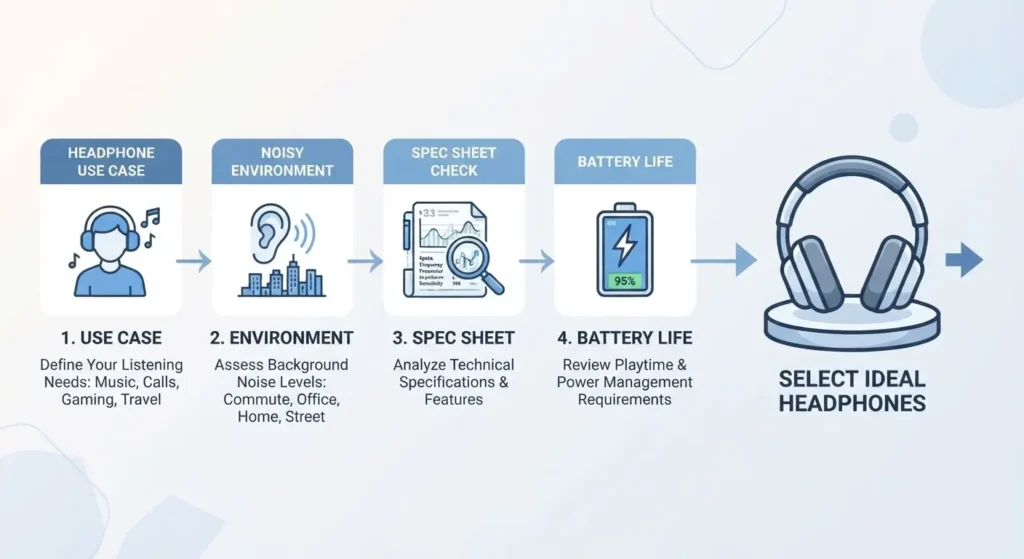
How to Decide Which You Need: A Simple 4-Step Process
Step 1: Identify your main use case. Ask yourself what you do more often: listening to audio, or talking to people. If your headphones are mostly for music, podcasts, or focus work, lean ANC. If they are mostly for calls, meetings, or gaming with a squad, lean ENC.
Step 2: Check your environment. Loud commutes, flights, or shared offices push you toward ANC. Frequent calls from unpredictable, noisy spots like cafes, streets, or a home with kids push you toward ENC.
Step 3: Look at the specs, not just the marketing. Product listings often say “noise cancelling” without specifying which type. Search the product page or manual for ANC and ENC separately. Many mid-range and premium headsets now include both.
Step 4: Match battery life to your day. If you need all-day wear for meetings, ENC-heavy designs tend to last longer per charge. If you need a few hours of deep noise blocking on a flight, ANC battery drain is less of an issue since flights are finite.
Do You Need Both? Combo Headsets Explained
ANC and ENC are not competing technologies. Many headsets now run both at once: ANC in the ear cups to quiet your listening, ENC in the microphone array to clean your outgoing voice.
If your day mixes deep focus work, commuting, and frequent calls, exploring our Headphones Collection can help you find a combo model that removes the need to switch devices. The tradeoff is usually price and, in some models, battery life, since running both systems draws more power than running one.
Before buying a combo headset, check reviews for how the two systems behave together. Some cheaper combo products advertise both features but perform each one poorly compared to a headset built around a single technology.
Safety Notes Before You Buy
- Avoid relying on ANC while cycling, driving, or crossing streets. Blocking traffic and horn sounds removes an important safety cue.
- Take breaks from ANC if you notice ear pressure or discomfort during long sessions.
- Test call quality with ENC headsets in your actual work environment before committing, since performance varies by microphone placement and brand.
- Keep volume at a safe level even with ANC active. Cancelling background noise does not make loud audio in your ears any safer for your hearing.
Frequently Asked Questions
Does ANC improve call quality for the person I’m talking to? No. ANC only changes what you hear. It does nothing for your outgoing voice. If callers say they can’t hear you clearly, you need ENC, not stronger ANC.
Can headphones have both ANC and ENC at the same time? Yes. Many modern earbuds and headsets combine both, with ANC handling your listening experience and ENC handling your microphone. Check the product specs to confirm both are listed separately.
Which one drains the battery faster? ANC typically uses more power because it constantly processes and cancels incoming sound. ENC tends to use less power since it only processes your voice during calls, which is one reason ENC-focused devices often report longer battery life.
Is ANC bad for your ears? ANC itself does not damage hearing. Some users feel mild ear pressure from the noise cancellation effect, similar to altitude changes. If it bothers you, lower the ANC intensity or take breaks.
Do I need ANC for gaming headsets? Not necessarily. Gaming headsets prioritize ENC so your teammates hear you clearly during matches. ANC is a nice extra for blocking room noise, but it is not the main feature that matters for team communication.
Can open-ear headphones have ENC? Yes. Since ENC only needs a microphone array near your mouth, it works on open-ear designs too, unlike ANC, which generally needs a sealed fit to cancel sound effectively.
Final Thoughts
ANC protects your ears from the world. ENC protects your voice from the world. Neither one replaces the other, and the best choice depends on whether your headphones spend more time playing audio to you or carrying your voice to someone else.
If you can only afford one feature, match it to your loudest, most frequent use case. If your days mix both calls and commutes, a combo headset saves you from carrying two devices.
Further Reading
- ENC vs ANC comparison and specs breakdown: https://www.electronicshub.org/enc-vs-anc/
- ANC and ENC use cases explained: https://www.bajajfinserv.in/enc-vs-anc-headphones
- How ANC and ENC work under the hood: https://nuroum.com/blog/enc-anc-differences