
Your child begs for headphones before every school trip. You hand over a pair, then worry the volume sits too high during a long flight or a quiet study hall. This worry is fair. The Centers for Disease Control and Prevention reports roughly 12.5% of children between ages 6 and 19 already show measurable hearing loss in one or both ears, and personal listening devices play a role in that number.
If you are searching for the best kids headphones for school and travel, this guide walks you through what a safe pair needs, which volume-limited models hold up on a long flight, and how to test a pair before your child wears one all day.
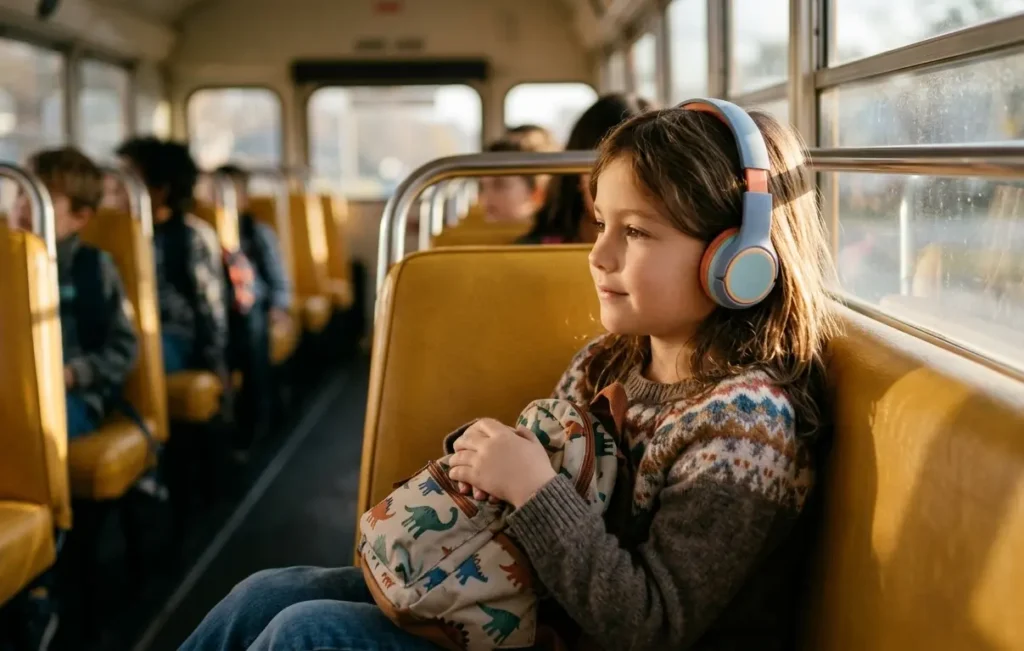
Why Volume Limits Matter for Children
A child’s ear canal sits shorter and narrower than an adult’s. Sound pressure builds faster inside a small canal, so the same volume setting hits a child’s eardrum harder than it hits yours. The National Institute on Deafness and Other Communication Disorders states sounds at or below 70 decibels rarely cause damage, even after long exposure, while repeated exposure at 85 decibels or above raises the risk of permanent hearing loss.
Standard headphones often reach 100 to 110 decibels at full volume. Five to fifteen minutes at that level already carries risk, according to audiologists cited by hearing clinics that study the 60/60 rule: keep volume at 60% of the maximum and cap listening sessions at 60 minutes.
Headphones built for children add a hardware or software cap, usually set near 85 decibels, so a child cannot accidentally reach a damaging level, even with the volume slider pushed all the way up.
What to Check Before You Buy
1. A True Volume Cap, Not a Marketing Label
Not every headphone marked “kid safe” performs as advertised. Wirecutter tested a batch of volume-limiting headphones and found close to a third allowed sound past 85 dBA, and nearly half crossed that line once real music replaced test tones. A few models let a determined kid bypass the limiter through a settings menu on the paired device.
Look for a hardware-based limiter built into the headphone circuit itself, not a software setting on the tablet or phone. A hardware limiter stays active no matter which device your child connects to.
2. Comfort for Small Heads
A headband that pinches after twenty minutes gets pushed off the ears, which usually leads to a child cranking the volume louder on the source device to compensate for a poor seal. Check for:
- Adjustable, padded headbands
- Soft, breathable ear cushions
- Lightweight builds under 200 grams
- A folding hinge for backpack storage
3. Durability for Daily Wear
A headphone that survives a locker, a backpack side pocket, and a plane seat pocket needs a sturdier build than one meant for a living room couch. Priorities here:
- A tangle-resistant, reinforced cable if wired
- A hard-shell or padded travel case
- Foldable arms that reduce stress on hinges
- A battery rated for at least 20 hours if wireless, since a long travel day drains a weak battery fast
4. Wired vs. Wireless for School Rules
Many schools restrict Bluetooth devices during test periods or class hours. A wired pair with a standard 3.5mm jack works with school-issued tablets, most airplane entertainment systems, and older devices without extra adapters. If your child needs Bluetooth for a school-issued Chromebook with no headphone jack, pick a model that supports both wired and wireless modes.
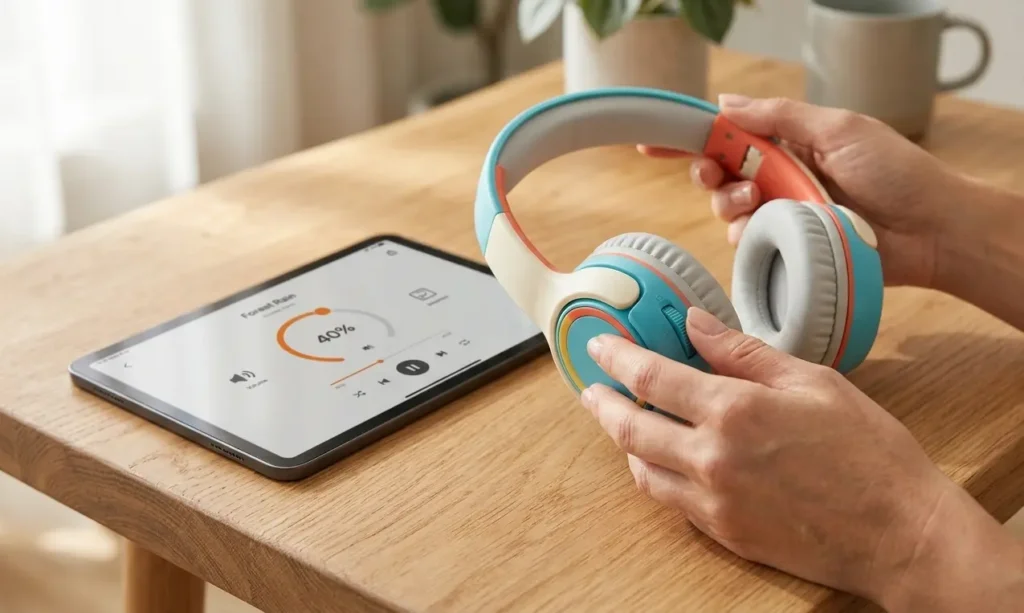
Real Scenario: A Parent’s Flight Story
A mother named Sarah booked a nine-hour flight with her seven-year-old son last spring. She packed a cheap pair of headphones from a discount store, thinking any pair would do. Two hours into the flight, her son pulled the headphones off and complained about ear pain. She checked the volume on the tablet and found the sound already near max, since the headphones offered no built-in limit and the cabin noise pushed him to raise the volume higher and higher.
On the return flight, she used a pair with a hardware 85 dBA cap instead. Her son kept the headphones on for the full flight, and the volume stayed capped no matter how high he pushed the on-screen slider. That single change, choosing gear with a real limiter over a generic pair, saved the second half of a long trip.
Best Kids Headphones for School and Travel
These options fit a backpack, survive daily handling, and hold a genuine 85 dBA cap based on independent lab testing and manufacturer specifications.
- Puro Sound Labs BT2200 over-ear, Bluetooth and wired modes, hardware-limited to 85 dB, roughly 18 hours of battery life, padded headband suited for full school days.
- JBL JR310 lightweight over-ear design, foldable, wired 3.5mm connection, volume-limiting technology built into the driver, priced for classroom budgets.
- iClever HS26 wired over-ear, 85 dBA safe volume tech, foldable arms, priced low enough to replace without a big loss if lost at school.
Top Picks for Travel
Long flights, road trips, and train rides need extra battery life, noise isolation, and a case that survives a carry-on bag.
- Puro Sound Labs PuroQuiet active noise cancellation paired with an 85 dB limit, useful for reducing the urge to raise volume over engine or cabin noise, comes with a hard travel case.
- Mpow CH6 wired and wireless modes, 85 dB volume limit, foam ear cushions for long-haul comfort, folds flat for a seat-back pocket.
- BuddyPhones Cosmos+ wireless, foldable, rated for roughly 24 hours of battery, volume capped at either 75 or 85 dB depending on the age setting selected by a parent.

Step-by-Step: How to Test a Pair Before Your Child Wears Them Daily
- Connect the headphones to a phone or tablet and play a familiar song.
- Push the on-device volume slider to maximum.
- Place the headphones over your own ears and judge whether the sound feels uncomfortably loud. A properly limited pair should sound loud, not painful.
- Check the fit on your child’s head. Ask them to shake their head side to side; the headband should stay in place.
- Leave the headphones on your child for a 30-minute session while you sit nearby. Ask them to report any pinching, itching, or heat buildup around the ears.
- Confirm the case or storage pouch closes fully and fits inside the school backpack or carry-on bag without extra pressure on the hinges.
- Review the manufacturer’s decibel specification sheet or product page, not just the box label, since some low-cost brands print a cap number without independent lab confirmation.
Extra Safety Habits Worth Building
A capped headphone reduces risk, but a few habits reinforce that protection:
- Teach the 60/60 rule: 60% volume, 60 minutes, then a break.
- Choose over-ear designs over in-ear buds when possible, since a properly fitted over-ear cup blocks outside noise and removes the temptation to raise volume to compete with background sound.
- Set device-level parental volume limits as a second layer of protection alongside the headphone’s own cap.
- Schedule a hearing check with a pediatrician or audiologist once a year, especially if your child uses headphones daily for schoolwork or long trips.
FAQ
What decibel level counts as safe for a child’s headphones? Most pediatric audiologists and the CDC point to 85 decibels as the ceiling for extended listening. Headphones marketed for children should cap out at or below that number, confirmed through independent testing rather than the box label alone.
Do volume-limiting headphones sound weaker than regular headphones? A well-built pair balances the driver and the limiter so sound quality stays clear at 85 dB. Cheaper models sometimes muffle sound at the cap, which pushes kids to raise the source device volume to compensate, so a limiter alone will not fix a poor speaker driver.
Are wireless headphones safe for young children? Bluetooth headphones carry low-power radio signals and current research shows no established link between typical Bluetooth exposure and hearing or health risk in children. The bigger safety factor stays the same: check the decibel cap, not the connection type.
How long should a child wear headphones each day? Audiologists commonly recommend listening sessions of 60 minutes followed by a break, with a daily total under three to four hours where possible, especially at home after a full school day already spent around classroom and hallway noise.
Do school-provided headphones usually include a volume limit? Many budget models schools hand out for testing or computer labs skip a hardware limiter entirely. Ask your child’s school about the brand used, and consider sending a personal capped pair for daily use if the school-issued pair lacks a confirmed limit.
What is the difference between a volume-limiting headphone and a noise-canceling one? A volume limiter caps the maximum output regardless of the source device setting. Noise cancellation blocks outside sound so a child does not need to raise volume to hear over engine noise or classroom chatter. The two features work well together, and several travel-focused models on this list combine both.
Sources and Further Reading
- CDC: Preventing Noise-Induced Hearing Loss in Children
- NIDCD, It’s a Noisy Planet: Are Volume-Limiting Headphones Safe for Your Child?
- NIDCD: Noise-Induced Hearing Loss
- American Tinnitus Association: Protecting Young People from Noise-Induced Hearing Loss